
The late 19th century was a time of incredible change. The Industrial Revolution had reshaped the world, with steam power and mechanization driving progress at an unprecedented rate. Yet, a new force was about to emerge, one that would illuminate the globe and power the future: electricity. As the world stood on the brink of this electrical age, two brilliant minds, Thomas Edison and Nikola Tesla, stepped forward. Their genius, fierce competition, and groundbreaking innovations would lay the foundation for the commercial power generation systems we rely on today.
Thomas Edison: The Wizard of Menlo Park
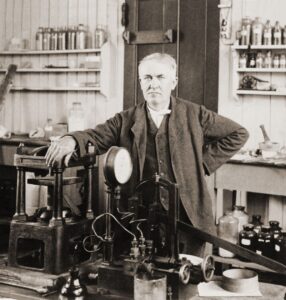
Thomas Alva Edison is a name synonymous with invention. A self-taught prodigy from Ohio, his relentless curiosity and business acumen made him a dominant figure in American innovation. While many associate him with the light bulb, his true contribution to commercial power was creating an entire system to support it.
Edison’s vision was not just to invent a single product but to build an electrical utility. He understood that for his incandescent light bulb to succeed, customers needed a reliable and safe source of power delivered directly to their homes and businesses. This led him to develop a direct current (DC) system.
Key Milestones:
- 1879: Edison perfects a commercially viable and long-lasting incandescent light bulb.
- 1882: He opens the Pearl Street Station in Lower Manhattan, New York City. This was the world’s first central power plant, initially serving 85 customers with 400 lamps.
- System Development: Beyond the power plant, Edison’s team developed all the necessary components for a DC grid, including generators (which he called “dynamos”), insulated wiring, fuses, and electric meters to bill customers.
A lesser-known fact is how Edison approached safety. To convince a skeptical public that electricity was safe for home use, he insisted on running all the wiring for his Pearl Street system underground. This was a massive and expensive undertaking at the time. His focus was on creating a complete, end-to-end solution. This positioned his company, Edison General Electric, as a total power provider.
Nikola Tesla: The Visionary Genius

Nikola Tesla, a Serbian-American inventor and engineer, was a visionary whose ideas were often far ahead of his time. After arriving in the United States in 1884, he briefly worked for Thomas Edison. However, their partnership was short-lived due to fundamental disagreements over electrical systems.
Tesla was a fervent advocate for alternating current (AC). He recognized that DC power, while effective, had a major limitation: it could not be transmitted efficiently over long distances. Power plants would need to be built every few miles, making widespread electrification impractical. AC, on the other hand, could be “stepped up” to high voltages for long-distance transmission and then “stepped down” for safe use in homes and factories.
Key Contributions:
- AC Induction Motor: Tesla’s invention of the polyphase AC induction motor was a game-changer. It was simple, reliable, and required little maintenance, making it perfect for industrial applications.
- Partnership with Westinghouse: After parting with Edison, Tesla partnered with George Westinghouse, who saw the commercial potential of AC. This partnership provided the financial backing to challenge Edison’s DC empire.
- The “War of the Currents”: The rivalry between Edison’s DC and Tesla’s AC systems became a fierce public battle. Edison, in an attempt to discredit AC, publicly demonstrated its dangers, while Tesla and Westinghouse focused on showcasing its efficiency and superior range. The decisive moment came when Westinghouse won the contract to illuminate the 1893 World’s Columbian Exposition in Chicago with AC power, dazzling millions and proving its viability.
A Tale of Two Systems: Edison vs. Tesla
| Feature | Thomas Edison (Direct Current – DC) | Nikola Tesla (Alternating Current – AC) |
| Power Type | Direct Current (flows in one direction) | Alternating Current (reverses direction periodically) |
| Transmission | Inefficient over long distances | Highly efficient for long-distance transmission |
| Key Invention | The complete electrical utility system | The AC induction motor & polyphase system |
| Business Model | Sell a full, integrated system (bulbs, wiring, power) | License patents and partner with manufacturers |
| Major Backer | Self-funded (Edison General Electric) | George Westinghouse (Westinghouse Electric) |
| Legacy | Pioneered the concept of a central power station | Designed the system for global electrification |
The Enduring Impact on Today’s Energy Landscape
Though Edison and Tesla were rivals, their combined contributions created the modern electrical world. The “War of the Currents” ultimately ended with AC becoming the dominant standard for power generation and transmission, a testament to Tesla’s foresight. Today, every time you plug an appliance into a wall outlet, you are tapping into a system built on his principles.
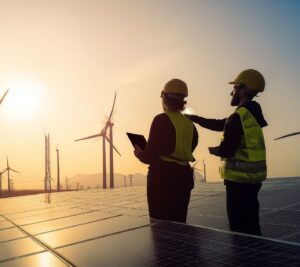
However, Edison’s legacy is equally profound. He conceptualized and executed the world’s first commercial power utility, proving that electricity could be a safe, reliable, and profitable commodity. His model of a central power station serving a network of customers remains the core of our energy infrastructure. In a fascinating modern twist, direct current is seeing a resurgence in applications like solar panels, batteries, and data centers, proving that Edison’s original ideas still hold value.
Together, these two pioneers, the pragmatic industrialist and the brilliant visionary, electrified our world. They transformed a scientific curiosity into the essential utility that powers our homes, industries, and digital lives, leaving an indelible mark on human history.
Frequently Asked Questions (FAQs)
Did Edison really invent the light bulb?
While he didn’t invent the very first electric light, Edison developed the first commercially practical and long-lasting incandescent light bulb in 1879. His version could burn for hundreds of hours and was part of a complete system, making it a viable product for the public.
Why did Tesla and Edison stop working together?
The two had a major falling out over both money and scientific principles. The most frequently mentioned incident concerns a payment disagreement regarding upgrades to Edison’s DC dynamos. Ultimately, their differing visions for electricity’s future, favoring either DC or AC, prevented any lasting collaboration.
Who won the “War of the Currents”?
Nikola Tesla and George Westinghouse ultimately won. Their AC system was chosen to power the 1893 Chicago World’s Fair and was later selected for the Niagara Falls hydroelectric project. These successes demonstrated AC’s superiority for large-scale power distribution, and it became the global standard.
What happened to Nikola Tesla?
Despite his brilliant mind, Tesla struggled financially for much of his life. He was a visionary, not a businessman, and sold many of his valuable patents to fund new research. He died in 1943, relatively poor and underappreciated, though his reputation has grown immensely in recent decades.
Is DC power still used today?
Yes. While AC is used for grid transmission, DC power is essential for modern electronics. Everything from your smartphone and laptop to electric vehicle batteries and solar panels runs on DC. Power adapters for your devices work by converting the AC power from your wall outlet into the DC power your electronics need.